
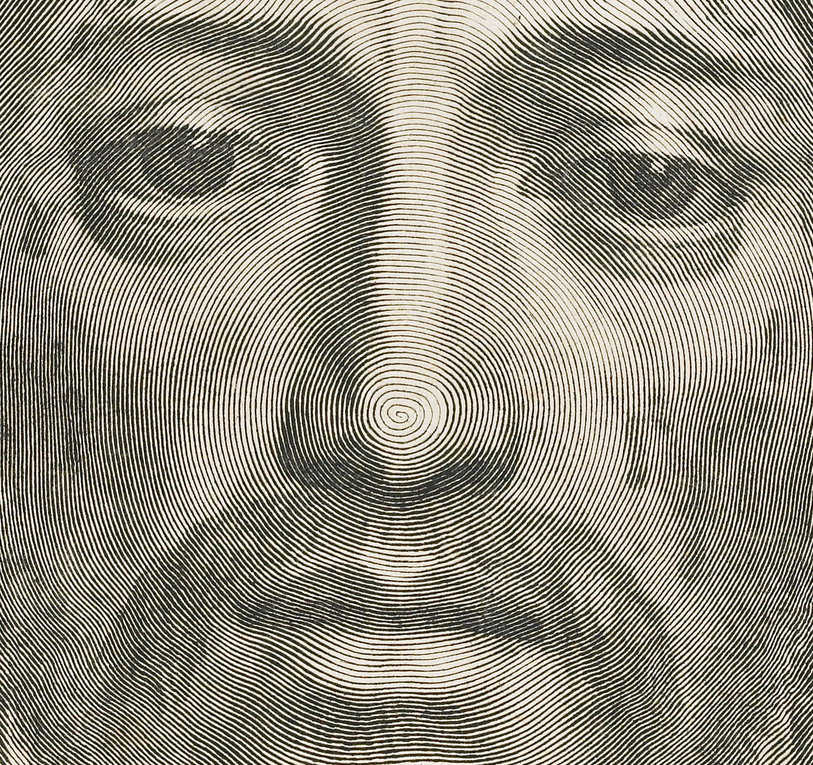
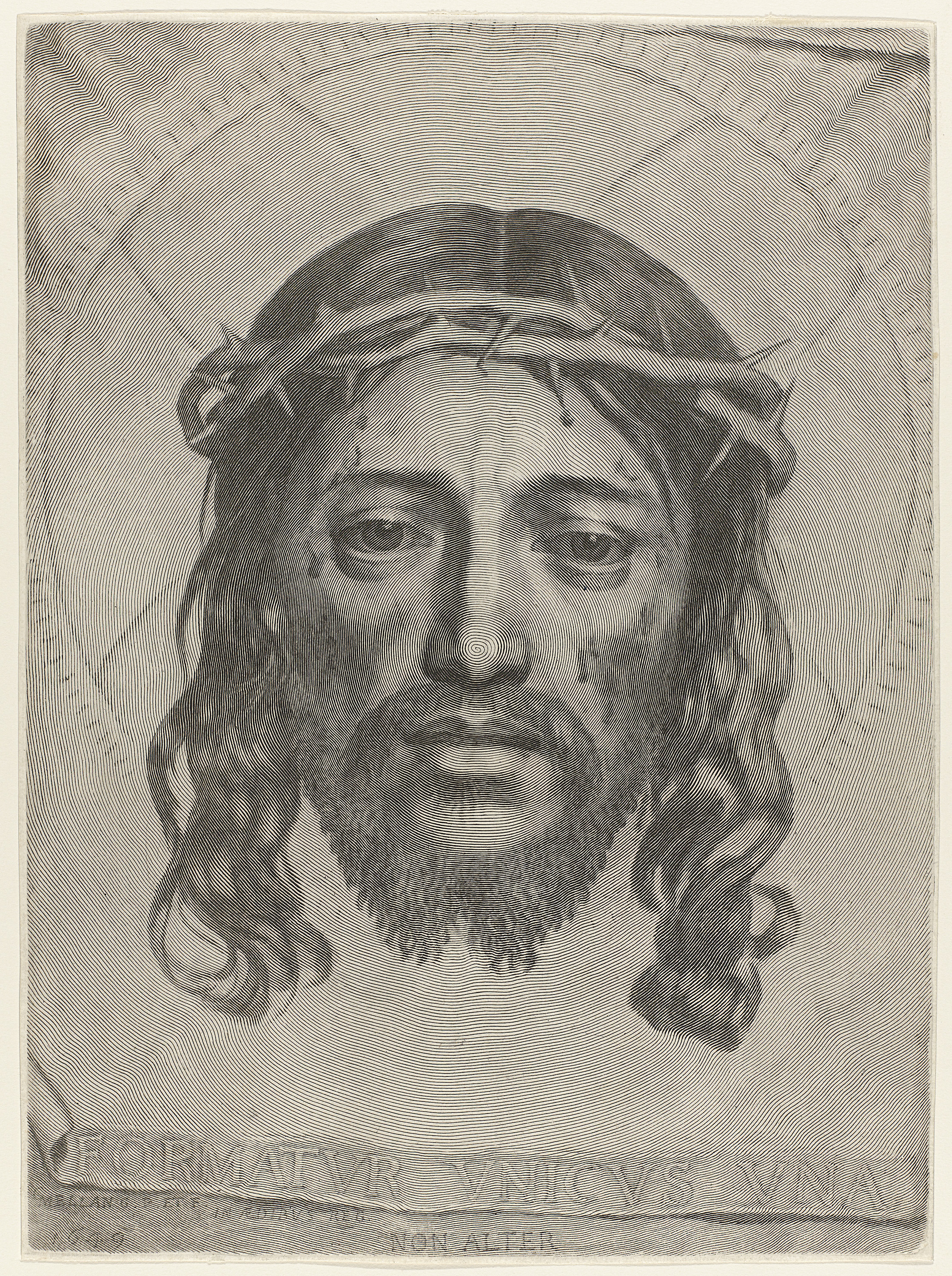
Look at Claude Mellan's The Sudarium of Saint Veronica from 1649. Go ahead, get close. You'll see a face of Christ that seems to float off the page, haloed and sorrowful, blood dripping from the crown of thorns. But then you'll notice something else. The texture on the nose looks like a fingerprint whorl. The eyes have a ringed pattern. And if you follow any line, you'll realize it never ends. It just keeps spiraling, from the tip of the nose outward, covering the entire image.
This engraving was made with a single, unbroken line. One continuous spiral, incised into a copper plate with a burin that never lifted from the metal. Not once. That's not an exaggeration. That's the actual technique, and it's as insane as it sounds.
The Man Behind the Spiral
Claude Mellan was born in 1598 in northern France, into a family of coppersmiths. That detail matters. He grew up around metal, understanding how it moved and cut. Later, he trained in Rome under the painter Simon Vouet, but it was the family trade that gave him his edge. By 1649, at age 51, he produced his masterpiece: an engraving titled The Sudarium of Saint Veronica, referencing the cloth that supposedly bore Christ's image after Veronica wiped his face on the way to Calvary.
The sudarium is what's called an acheiropoieta—an image made without hands. Think the Shroud of Turin. The irony is thick: Mellan made this image with his hands, with a tool, and with a level of control that feels almost superhuman. But the result has that same indexical quality, as if the copper plate itself had been pressed against Christ's face.
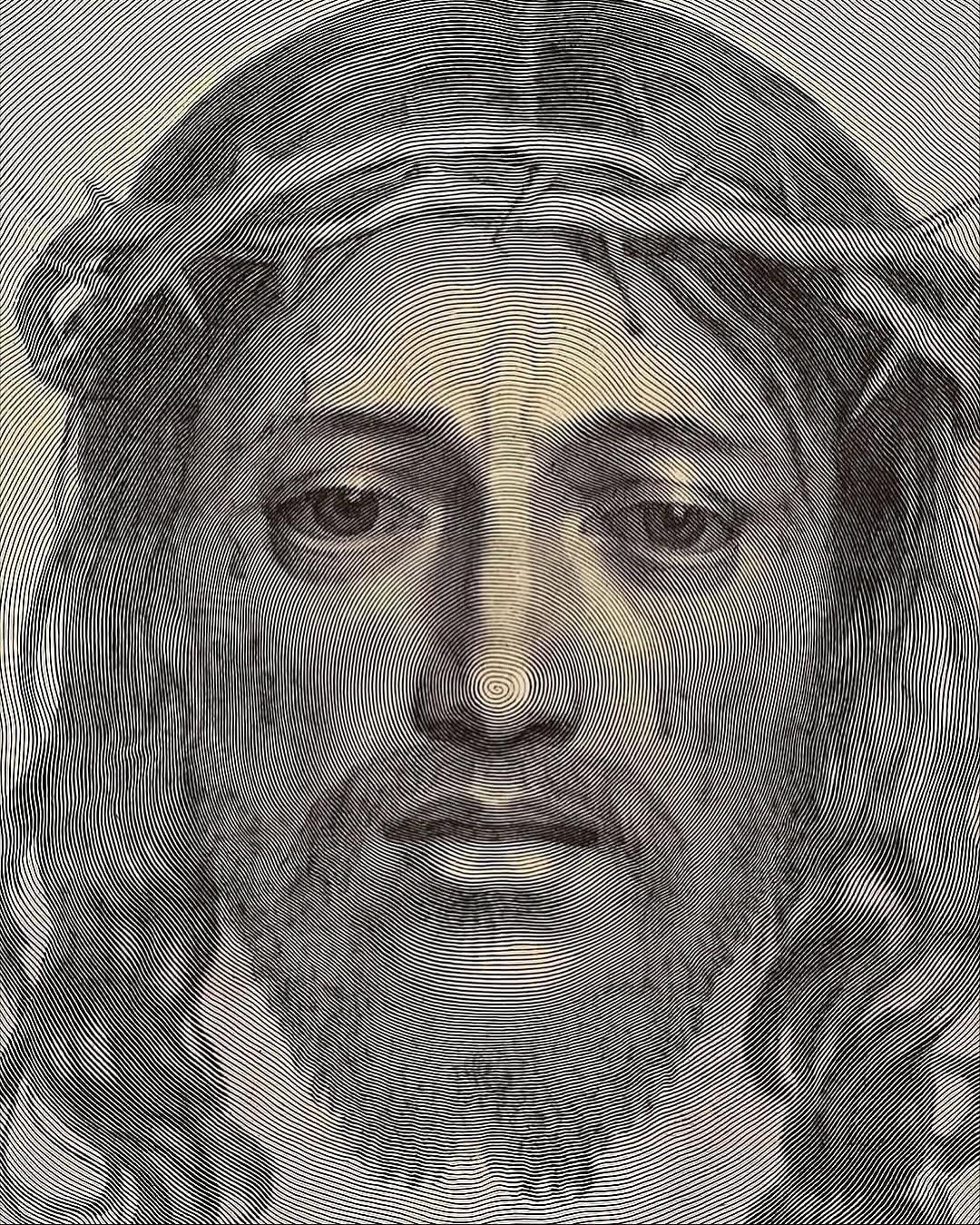
The Swelling Line: Physics Meets Faith
The technique Mellan used is called the "swelling line." It exploits the asymmetrical profile of the burin, the V-shaped engraving tool. If you hold a fountain pen at different angles, the line swells and thins. Same principle. Mellan would rotate his burin as he pushed it through the copper, varying the width of the groove. That's how he created shading, depth, and texture without ever lifting the tool. The line gets thicker in the shadows, thinner in the highlights, and the whole image emerges from a single path.
Engraving itself had been around since about 1430 in Germany, an offshoot of goldsmithing. But swelling lines weren't common until after the 1560s. And even then, nobody used them like Mellan did. Most engravers used cross-hatching—lots of parallel lines crossing at angles—to build up tone. Mellan said, "No thanks. One line." It's like someone deciding to write a novel without using the letter E. Possible, but why would you do that to yourself?
And that's the thing. He did it because he could. And because it made the image feel miraculous. The RISD curators noted that the swelling line technique was particularly suited for "reproducing the dramatic light and tonal effects of paintings as well as the exaggerated, heroic forms of late Renaissance and Mannerist art." Mellan used it for a different kind of drama: the holy afterglow of a relic. The single line gives the image a continuous, almost vibrating energy. It's a picture; it's a performance.
The Endurance Problem
Here's what gets me. How long did this take? We don't know exactly, but think about it. Copper is soft but not that soft. Every push of the burin takes force. And Mellan couldn't stop. He couldn't rest his hand, couldn't shake out a cramp, because the moment he lifted the burin, the line would break. Did he work in a single sitting? That seems impossible. But if he stopped, how did he resume the line seamlessly? The intersections would show.
There's a reason so many people online refuse to believe this is a single line. They claim he used a projection device, or that the shading in between the lines was added later, or that it's just an elaborate hoax. One commenter on Reddit said, "All one line, except the shading in between the lines." And I get it. The human brain wants to find the trick. But the trick is that Mellan was just that good. Or maybe he was that obsessed.
He lived to be 90, and he produced over 400 engravings in his lifetime. That's a career of relentless precision. Imagine the eye strain. The hand cramps. The sheer monotony of pushing a needle through metal for decades. And yet, this is what he's remembered for: one line, spiraling out of a nose, becoming a face, becoming a relic.
Why It Still Matters
Roland Barthes, writing about photography, invoked Veronica's veil: "Photography has something to do with resurrection: might we not say of it what the Byzantines said of the image of Christ which impregnated St. Veronica's..." Mellan's engraving sits right at that intersection of image and imprint. It's a print that acts like a relic. And the single line makes it feel even more direct, like a seismograph of the artist's hand.
In an age of AI-generated art, where images appear with a word and have no physical weight, Mellan's engraving feels like a relic from another universe. It's the opposite of effortless. It's all effort, all control, all human. And that's why it still stops people in their tracks. You can't fake that kind of commitment.
So the next time someone tells you that art is just about talent, show them this. It's not talent. It's 51 years of living with copper, a family legacy of metal, and an almost pathological refusal to lift a tool. That's what it takes to make a single line do the impossible.