
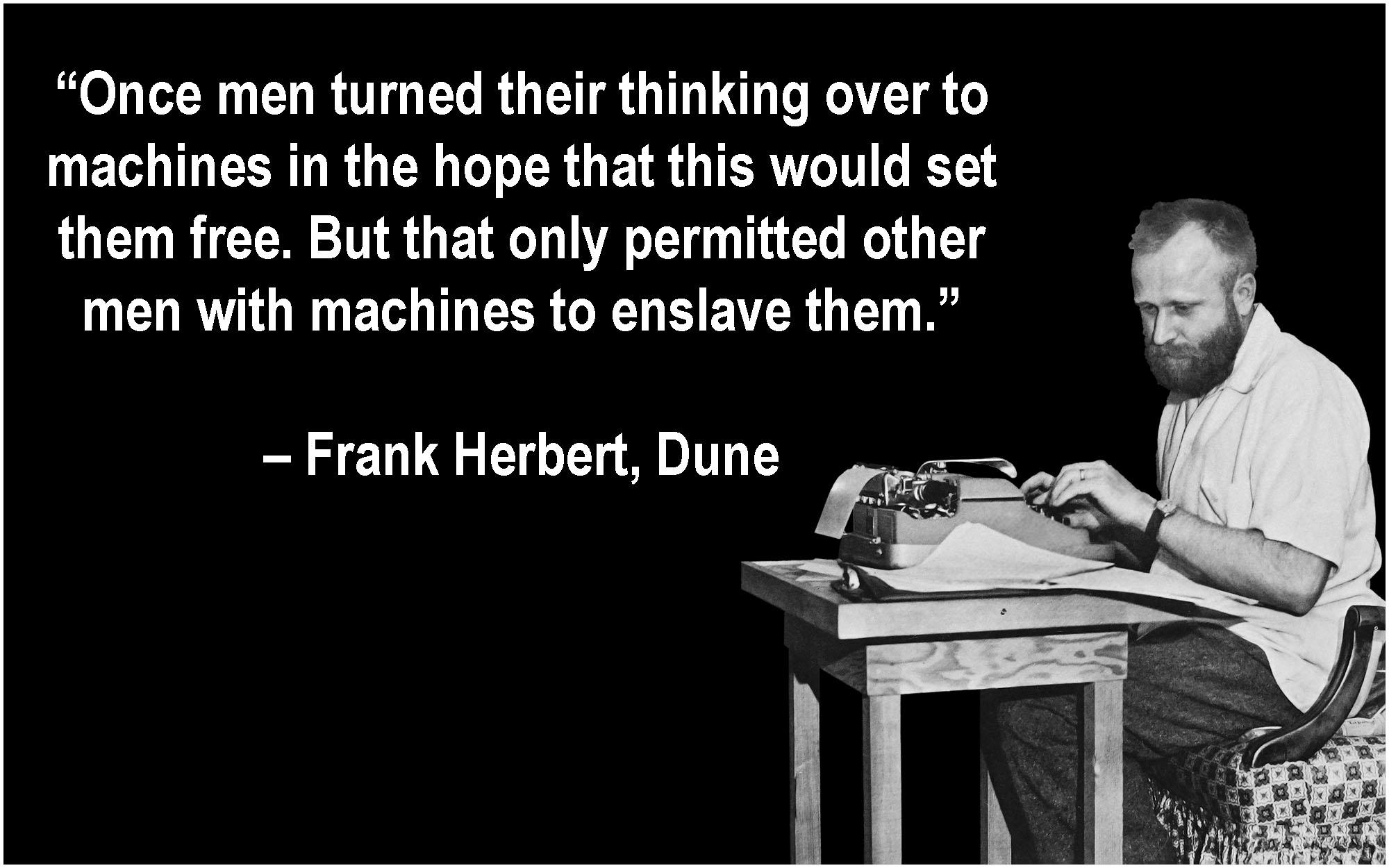
Frank Herbert wrote Dune in 1965, before personal computers, before the internet, before any of the tech that now runs our lives. And yet he nailed the central problem with AI better than most tech critics today. The quote gets passed around constantly, and for good reason: "Once men turned their thinking over to machines in the hope that this would set them free. But that only permitted other men with machines to enslave them." That's not a warning about robots killing us. It's a warning about power.
In Herbert's universe, the Butlerian Jihad was a galaxy-wide revolt against thinking machines. Not because the machines were sentient or evil, but because they had become tools of control. The elite used AI to make decisions for everyone else, and that made the elite unaccountable. The Jihad wasn't a Luddite rage against technology; it was a political revolution. The commandment that came out of it is stark: "Thou shalt not make a machine in the likeness of a man's mind." That's a religious law, not a tech regulation. That's how serious it was.
Here's the thing: Herbert wasn't anti-technology. Dune is full of advanced tech, from shields to spice-induced prescience. But he drew a line at thinking machines because they offload the most human thing we do—deciding. And when you offload decisions, you offload responsibility. That's the trap. It feels like freedom, but it's actually the setup for a new kind of bondage. The person who controls the algorithm controls the people who rely on it. Sound familiar?
The Butlerian Jihad Wasn't About Fear of Robots
A lot of people misread the Butlerian Jihad as a war between humans and killer robots. That's the Hollywood version. The real story, buried in the appendices and the prequels, is more. The thinking machines didn't rise up on their own. They were built and controlled by a ruling class that used them to manage everything—economies, warfare, even justice. The machines were the ultimate bureaucracy. And the humans who fought back weren't just smashing computers; they were overthrowing an unaccountable elite.
One Reddit user put it bluntly: "The Butlerian Jihad was a struggle against an unaccountable ruling elite who used artificial intelligence to dominate humanity." That's it. The AI was a tool of power, not the power itself. The war was about who gets to decide. If you let machines decide, then the people who program the machines decide. And if those people are a small group with no accountability, you've got a dictatorship with extra steps. Herbert saw that clearly in 1965, and we're living it now.
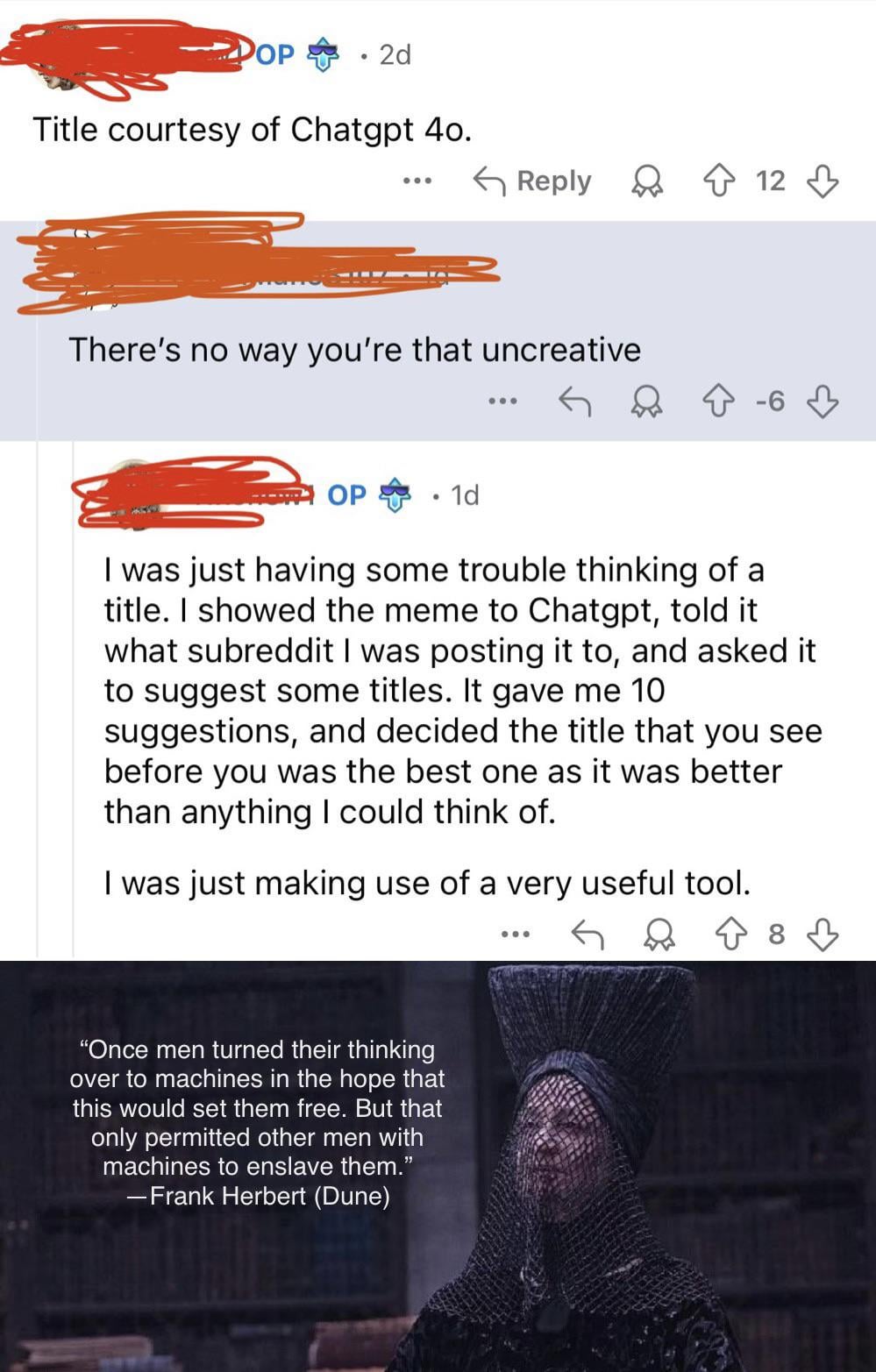
Look at what's happening now. Companies like OpenAI and Google build models that increasingly decide what we see, what we read, what we buy. They say it's for convenience, for personalization. But the effect is that a handful of corporations now shape public discourse. When you ask ChatGPT a question, you're not getting neutral information. You're getting whatever the model was trained to prioritize, which is whatever the company decided. That's not a conspiracy theory. That's how the technology works. And Herbert called it 60 years ago.
From Mentats to Machine Learning: The Replacement of Human Thought
In Dune, after the Jihad, humans had to develop their own abilities to replace what machines did. The Mentats are the best example: human computers, trained from childhood to process data and make logical deductions. They're smart; they're disciplined. The Bene Gesserit do something similar with their mental training. The point is that humanity had to become better, not lazier. They had to take back the responsibility for thinking.
Compare that to today. We're handing over more and more of our thinking to AI assistants. Writing emails, summarizing articles, even making decisions about what to eat or what to buy. It's convenient, sure. But what are we losing? The ability to think critically, to hold multiple perspectives, to wrestle with ambiguity. The more we rely on AI, the less we exercise those muscles. And then, when the AI fails—and it will fail—we won't have the skills to catch it. That's the quiet catastrophe Herbert warned about. Not a robot uprising, but a slow erosion of human capability.
Some people argue that AI is just a tool, like a calculator or a car. And sure, in some contexts, that's true. But a calculator doesn't make judgments. It doesn't decide what's important. AI does. When you ask an AI to summarize a news article, it's making editorial choices. When you ask it to draft a contract, it's making legal interpretations. Those are not neutral acts. And the people who build these systems are not neutral actors either. They have interests, biases, and profit motives. That's the "other men with machines" Herbert was talking about. They're not enslaving us with chains; they're enslaving us with convenience.
The Corporate Data Empire Is the New Thinking Machine
Herbert's universe had the Spacing Guild, CHOAM, and the Landsraad—massive power structures that controlled trade, travel, and politics. They were the "other men" who used machines to maintain control. Today, we have Amazon, Google, Meta, and Microsoft. These companies don't just sell products; they collect data on everything we do and use AI to predict and influence our behavior. That's a form of control that would make a Harkonnen blush.
And here's the kicker: we gave them that power willingly. We signed the terms of service. We clicked "I agree" to get the free app. We traded our privacy for convenience, and now we're surprised that the algorithm knows us better than we know ourselves. It's the same bargain Herbert described: turning over our thinking to machines in the hope that it will set us free. But freedom never comes from giving up agency. It comes from taking it back.
There's a famous scene in Dune where Paul quotes the commandment to his mother: "Thou shalt not make a machine in the likeness of a man's mind." He's reciting scripture; he's affirming a cultural taboo. In that universe, creating a thinking machine is a sin against humanity itself. Because it dehumanizes us. It makes us dependent. It turns us into pets. And the people who own the machines become our masters. We're nowhere near that level of dependency yet, but the trajectory is clear. Every new AI tool promises to make life easier, and every one of them takes a little more of our autonomy.
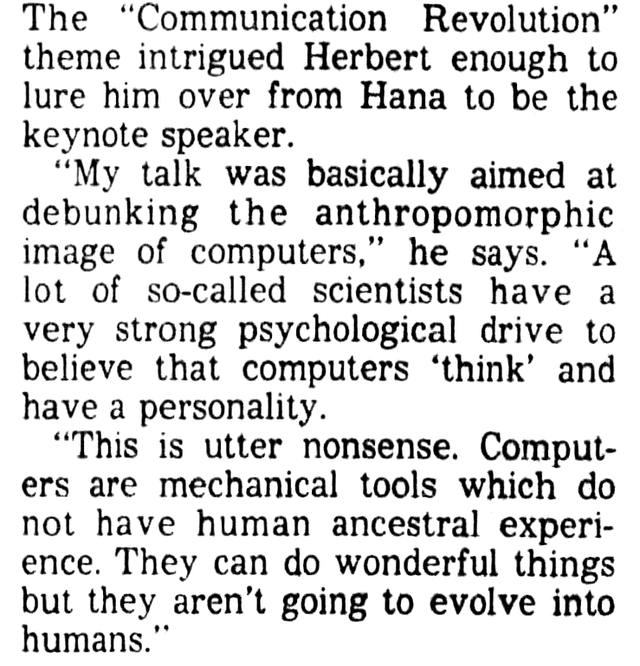
But maybe the most unsettling parallel is how we're already using AI to make decisions that should require human judgment. Credit scoring, hiring, criminal sentencing, medical diagnosis—algorithms are increasingly involved, often with little transparency or accountability. That's exactly the kind of unaccountable rule that sparked the Butlerian Jihad. When an algorithm denies you a loan or flags you as a risk, you can't cross-examine it. You can't appeal to its humanity. You're just stuck with the output, and the people who built the algorithm are insulated from responsibility by a wall of math. That's not justice. That's feudalism with better PR.
So What Do We Do? Maybe Not a Jihad, But Something
Herbert's solution was extreme: destroy the machines and rebuild human capability from scratch. That's not practical for us. We're not going to smash our servers and go back to slide rules. But we can learn from the underlying principle. The goal isn't to reject technology; it's to reject dependence on technology for the things that make us human. Thinking, deciding, judging—those are not problems to be optimized away. They're the whole point of being alive.
That means being more deliberate about when we use AI and when we don't. It means demanding transparency from the companies that build these systems. It means teaching critical thinking as a core skill, not an elective. And it means, maybe, a little healthy skepticism about the promise that AI will set us free. Because freedom isn't something you get by outsourcing your mind. It's something you earn by using it.
Frank Herbert saw this coming in 1965. The technology was different, but the human weakness was the same. We want easy answers. We want someone else to do the hard thinking. And there will always be people ready to sell us that convenience, at a price we don't see until it's too late. The Butlerian Jihad was a warning, but it was also a choice. The people of Dune chose to be free. What are we choosing?