
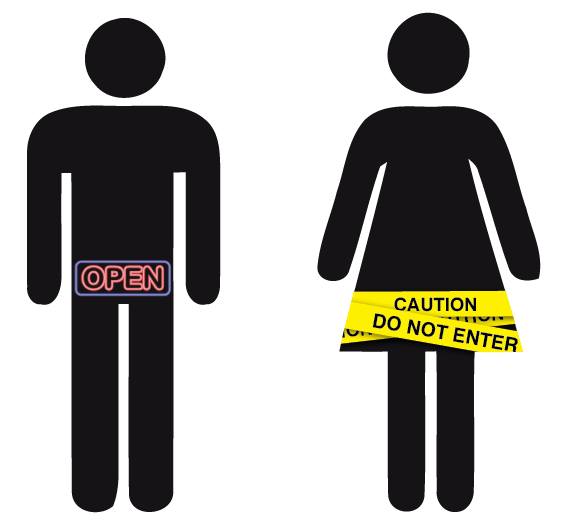
Here's a fun game: take a shot every time a woman gets called a 'bad feminist' for doing something with her own body that men have been doing since the dawn of time. You'll be dead by noon.
Sydney Sweeney is the latest contestant. The actress, best known for Euphoria and a pair of breasts that have inspired more thinkpieces than the entire collected works of Judith Butler, recently appeared in an American Eagle campaign. She wore jeans. She looked good. And apparently, that was enough to kick off a fresh round of hand-wringing about whether she's 'setting feminism back.'
Let's be clear about what actually happened: a conventionally attractive woman in her twenties posed for an ad campaign for a clothing brand. That's it. That's the scandal. But you wouldn't know it from the discourse, which quickly escalated to accusations of 'sexualizing women's sport' and 'making a mockery of women in sport,' as The Guardian reported. Boxer Skye Nicolson was among the critics, framing the backlash as being about respect rather than looks. Sure.
The thing is, this isn't new. It's not even particularly interesting. It's the same tired script that has played out every time a woman in the public eye dares to be both attractive and unapologetic about it. But what's striking this time is how perfectly the Sweeney saga illustrates the impossible bind that feminism has created for women: you're damned if you're sexy, damned if you're not, and if you're really lucky, you get to be both at once.
The Double Standard That Won't Die
Let's talk about the actual research, because this isn't just vibes. A 2024 study published in Psychology of Women Quarterly found that in Western societies, women are encouraged to present themselves in sexualized ways and are expected to experience this as a form of sexual agency. Read that again. Women are encouraged to be sexualized, but then they're punished for doing it too well, or too publicly, or in a way that doesn't align with whatever the current feminist orthodoxy says is acceptable.
The study, by S. Balint, has been cited 28 times since publication. That's a lot for an academic paper, which tells you something about how desperate people are to make sense of this mess. The takeaway is uncomfortable: the same culture that tells women to flaunt it also tells them they're doing it wrong. It's a rigged game, and the only way to win is not to play. But try telling that to a 26-year-old actress whose entire career is built on being looked at.
And it's a Western problem, though we love to pretend it is. The World Health Organization's 2024 bulletin on sexual empowerment measures notes that younger and unmarried women face even greater societal stigma in many low- and middle-income countries. So the double standard is global, it's intersectional, and it's not going anywhere. Great.
The 'Fruit of Feminism' Argument Is a Cop-Out
Of course, there's a whole contingent that thinks Sweeney's very existence is proof that feminism has failed. Crisis Magazine went full pearl-clutch, declaring that her actions are 'nothing more than the fruit of feminism' and 'actually degrading to women.' This is sexual liberation taken to its logical extreme, apparently. As if a woman in jeans is the inevitable endpoint of a century of fighting for the vote.
This argument is so lazy it's almost impressive. It conflates a woman's choice to be sexy with a systemic oppression, ignoring the fact that the real degradation comes from being told what to do with your body by people who have no skin in the game. The Crisis writer seems to think that if women just covered up a little more, we'd all be living in a utopia where everyone respects each other. Spoiler: we wouldn't. We'd just have different outfits and the same old double standards.
And let's not forget the Facebook commentariat, who weighed in with their usual nuance: 'She asserts that Sweeney is not a feminist and is actually setting feminism back by being a representative of all women, including the male gaze.' Ah yes, the male gaze. That monolithic entity that apparently turns any woman who dares to be attractive into a traitor to her sex. Here's a thought: maybe the problem isn't the male gaze. Maybe the problem is that we've spent so long policing women's bodies that we've forgotten they actually belong to the women themselves.
The Envy Factor: Why Some Women Hate Seeing Other Women Win
But let's get real for a second. A lot of the backlash against Sweeney isn't about feminism at all. It's about envy. It's about the fact that she's young, she's rich, she's successful, and she's objectively gorgeous by conventional standards. And she's not apologizing for any of it. That drives certain people absolutely insane.
There's a whole online ecosystem dedicated to tearing down women like Sweeney, and it's not coming from where you'd think. The most vicious comments often come from other women. The ones who call her a 'pick-me' or accuse her of 'playing into the male gaze' or, in the immortal words of one internet genius, being 'a registered Republican, i.e., a right-winger' (as if that has anything to do with her body). It's a weird mix of political purity tests and good old-fashioned jealousy, and it's exhausting to watch.
Look, I get it. It's hard to see someone else succeed in a way that feels unearned, especially when they're doing it by leveraging their looks. But the answer isn't to tear them down. The answer is to build a world where women don't have to be beautiful to be valued, and where being beautiful doesn't automatically mean you're a bad person. That's a much harder project than snarking on Instagram, which is probably why so few people are doing it.
What Do We Actually Want?
So here's the question nobody wants to answer: what would a truly empowered female sexuality look like? Not the sanitized, academic version that requires a trigger warning and a discussion of intersectional power dynamics. I mean the messy, real-world version where women get to be hot, and cold, and contradictory, and sometimes just want to wear a low-cut top without it being a political statement.
The 2024 PMC article by Kågesten and colleagues argues that sexual empowerment measures should be inclusive of all women and girls, including younger and unmarried women who face greater societal stigma. That's a start, but it's still couched in the language of measurement and metrics. It doesn't capture the lived experience of being a woman who likes her body and wants to show it off without being called a traitor or a slut or a bad feminist.
Maybe the problem is that feminism has become too focused on policing individual choices and not focused enough on the structural forces that make those choices so fraught. We argue about whether Sydney Sweeney is a good feminist, but we don't argue about why a woman's worth is still so tied to her appearance in the first place. We don't argue about the fact that the same people who criticize Sweeney for being too sexy would probably criticize her for being too prudish if she covered up. It's a no-win situation, and the only way out is to stop playing the game entirely.
The Bottom Line
Sydney Sweeney is going to be fine. She'll keep making movies, she'll keep posing for ads, and she'll keep making a lot of money doing it. The people who are mad about it will keep being mad, and they'll find a new target next month. That's how the cycle works.
But the underlying issue isn't going away. Women are still caught between two impossible standards: be sexy, but not too sexy; be empowered, but not in a way that makes anyone uncomfortable; be confident, but not so confident that you stop caring what other people think. It's a trap, and the only way out is to recognize it for what it is.
The next time you see a woman being dragged online for being too attractive, too successful, or too unapologetic, ask yourself: what am I really angry about? Because it probably isn't about her. It's about the fact that the rules are broken, and nobody knows how to fix them. And until we do, we'll keep having the same tired arguments, over and over, while the Sydney Sweeneys of the world just keep winning.
And honestly? Good for them.