
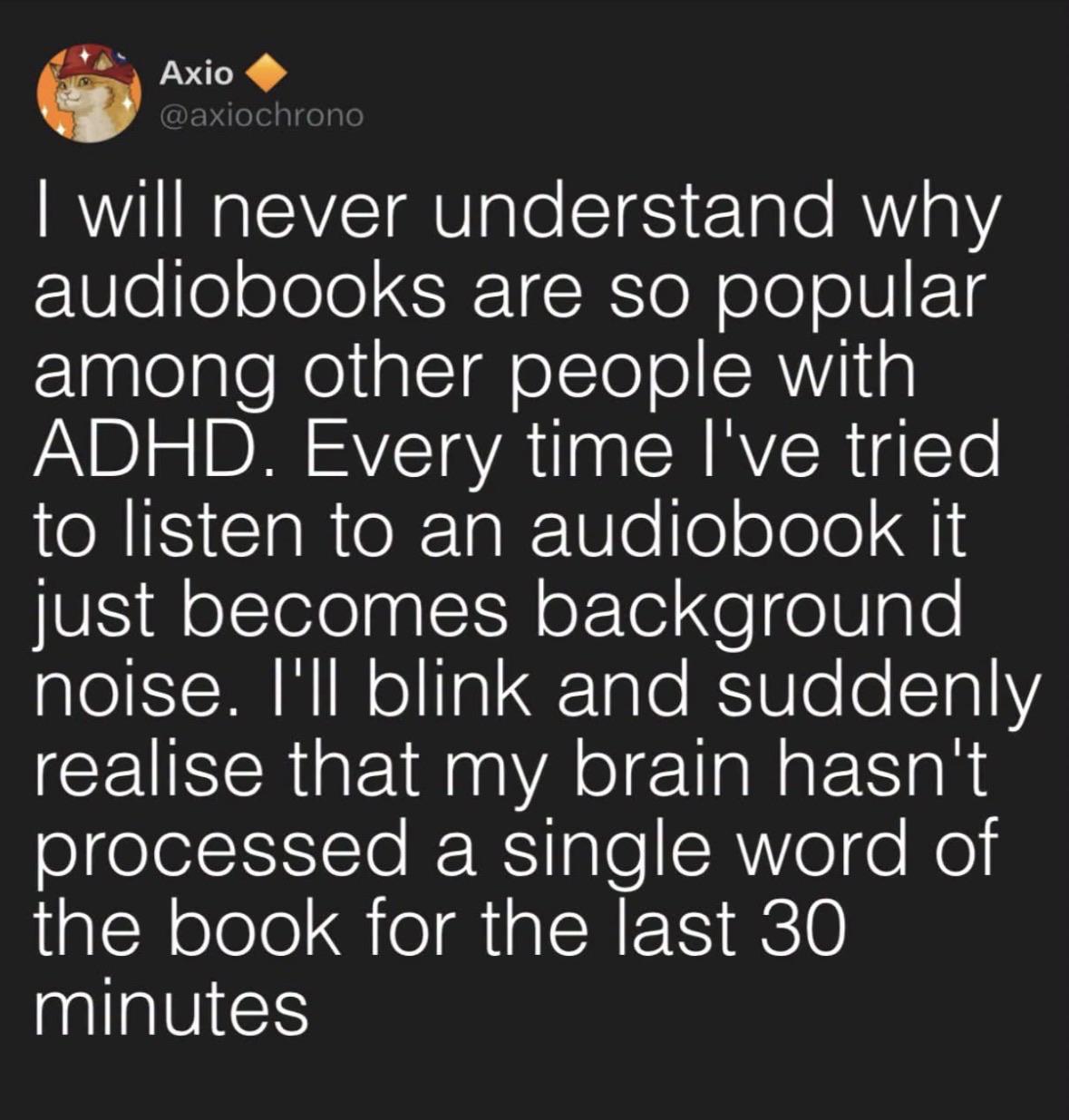
Here's the thing about audiobooks: they're the ultimate "should work" tool. You can walk, drive, fold laundry, do the dishes, all while "reading" a book. For people with ADHD, who often struggle to sit still with a physical book, audiobooks seem like a no-brainer. And yet, a massive number of neurodivergent folks will tell you they absolutely cannot follow an audiobook to save their life.
The comments on any ADHD forum are a split-screen of frustration and confusion. One person says they listen at 2x speed while doing chores and absorb every word. The next says they've tried the same book five times and the narrator's voice just turns into a soothing hum before they fall asleep or get annoyed and shut it off. It's not a matter of willpower. It's a fundamental difference in how some brains process auditory information.
So what's going on? Why does a tool that's constantly recommended as an accessibility win for ADHD actually backfire for so many of us?
The Extra Mental Load of Listening
Studies show that adults with ADHD often need more mental effort to process speech, even when their hearing is perfectly normal. That extra effort can make listening exhausting. Think about that for a second. The very act of decoding spoken words is more cognitively demanding for an ADHD brain. Now imagine sustaining that effort for the length of a novel. It's like trying to read a book while someone is constantly adjusting the lighting and you have to squint at every paragraph.
This is different from an auditory processing disorder (APD), though the two can coexist. Kids with APD often perform much better when information is presented visually rather than auditorily. They may miss social cues because they have to focus so hard on understanding the actual words being said. That's an important distinction: for some, the issue is the processing channel itself, not attention per se. But for many with ADHD, the problem is one of attention allocation. The brain has to work harder to stay locked onto the audio stream while simultaneously filtering out everything else.
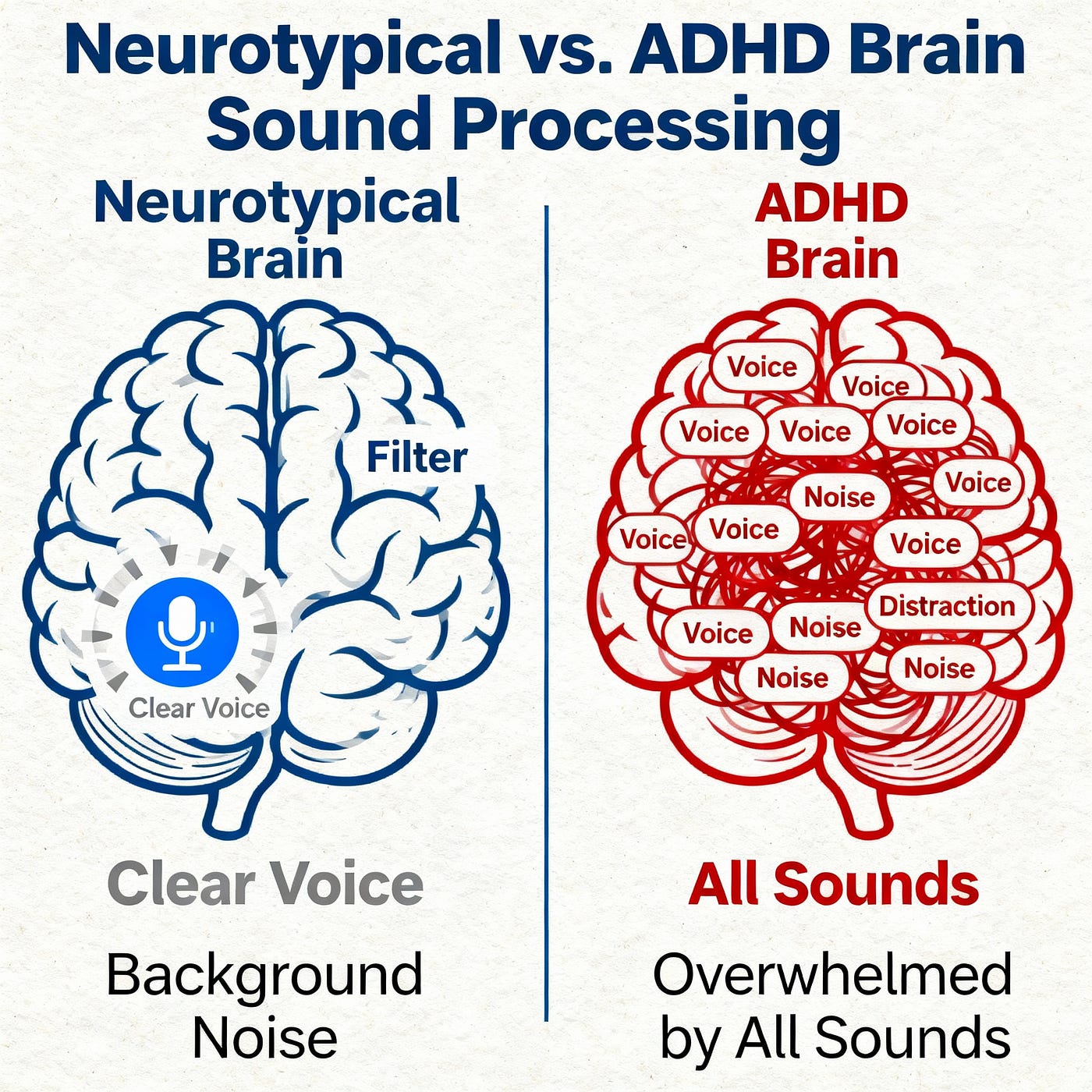
And no, it's not because you're "not trying hard enough." It's a neurological reality. ADHD is associated with deficits in visual-spatial processing too, but that's often less relevant when you're trying to follow a narrative. The problem is that audiobooks require sustained auditory attention, and that's exactly the kind of attention that's easily hijacked by a wandering mind, a sudden noise, or just the wrong narrator's voice.
The Dopamine Dilemma
Here's where it gets interesting: noise can actually help some ADHD brains focus. Background noise, like an auditory fidget, helps some adults with ADHD focus their brains. Others with noise sensitivity can't work to music. It's the same paradox. For some, a wall of sound provides enough stimulation to quiet the internal static. For others, that same sound is a distraction that makes everything worse.
The science behind this is called stochastic resonance. Noise induces stochastic resonance in the neurotransmitter systems and makes this noise beneficial for cognitive performance. In particular, the peak of the stochastic resonance curve depends on the individual. That means the optimal level of background noise is different for everyone. Some people need a coffee shop to focus; others need dead silence. Audiobooks sit in a weird middle ground. They're not background noise, but they're not a primary task either. They demand just enough attention to be frustrating if you can't allocate it properly.
So when you try to listen to an audiobook while doing something else, you're essentially asking your brain to split its attention. For an ADHD brain, that split can be catastrophic. The book becomes background noise, and the background noise becomes the book. You end up rewinding the same paragraph three times, or you realize you've "listened" to ten minutes of narration without retaining a single word.
The Myth of the One-Size-Fits-All Recommendation
Every article about "reading with ADHD" includes audiobooks as a top recommendation. And look, for some people, they're a. But the idea that they're universally helpful is lazy advice. It ignores the reality that attention is not a single dial. It's a complex system with multiple inputs and outputs. Some people can listen to an audiobook while driving because driving is so routine that it doesn't require conscious attention. The muscle memory takes over, and the brain can focus on the story. Others can't even listen to a podcast while washing dishes because the very act of washing dishes requires just enough focus to pull them out of the narrative.
There's also the issue of visual preference. Children with APD often perform much better when information is presented visually rather than just auditorily. That's an APD thing. Many people with ADHD simply process visual information more efficiently than auditory information. They might be able to read a physical book for hours, but a 30-minute audiobook chapter puts them to sleep. It's not a moral failing; it's a processing difference.
And then there's the emotional component. For some ADHDers, audiobooks are stressful. You're constantly worried about missing something, so you over-focus on the act of listening instead of the content. That hypervigilance is exhausting. You end up more tired than if you'd just read the damn book.
What Actually Works
So if audiobooks are a crapshoot, what's the alternative? First, let's kill the guilt. There's no moral superiority in reading a physical book versus listening to an audiobook versus using text-to-speech versus just reading a summary. The goal is to get the information or enjoy the story. How you do it is irrelevant.
For those who want to make audiobooks work, the key is finding the right secondary task. It has to be something that occupies your body without engaging your language centers. Walking is great. Cleaning is great. Driving on a familiar route is great. Anything that requires you to read, write, or make decisions will derail the listening. And don't be afraid to adjust the speed. Some people need 1.5x or 2x to keep their brain engaged. Others need 0.8x because the slower pace helps them process. There's no rule.
But here's the bigger point: if audiobooks don't work for you, that's okay. It doesn't mean your ADHD is "too severe" or you're not trying hard enough. It means your brain processes information differently. For many, visual reading is simply more efficient. And that's fine. The goal is to find what works for you, not to force yourself into a modality that makes you feel like a failure.
The next time someone tells you that audiobooks are the solution to your reading struggles, nod politely and then go do what actually works. Because the real solution isn't a format—it's understanding your own attention and building a system around it. That's not a compromise. It's self-awareness.