
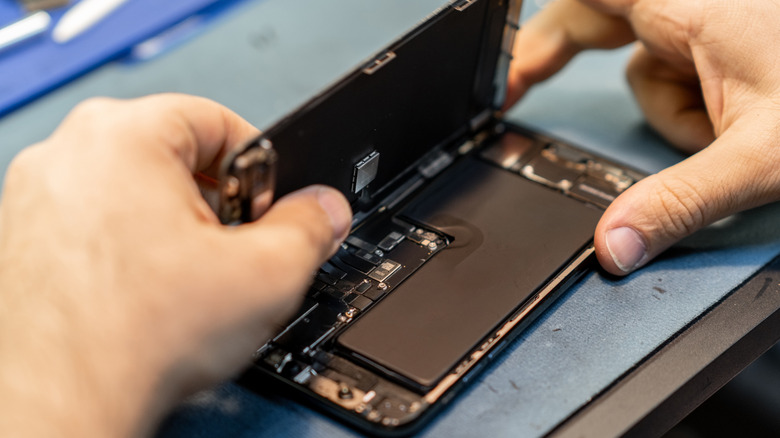
Here's a memory that'll date you: pulling a spare battery out of your pocket, popping the plastic back off your phone, and swapping in a fresh power cell while the old one charged in a dock on your desk. No tools, no repair shop, no $100 service fee. That was normal in 2007. It's unthinkable now.
What happened? The official story is that phones got too thin, too waterproof, too sophisticated for such a crude mechanism. The real story is simpler: sealed batteries make more money. And for 15 years, nobody with power cared enough to stop it.
Now the European Union is forcing the issue. Starting February 18, 2027, every phone, tablet, and gadget sold in the EU must have a battery that consumers can remove and replace without special tools. It's the biggest reversal in mobile design since the smartphone itself. And it's exposing a decade of convenient lies.
The Real Reason Your Battery Is Glued In
Let's get the engineering out of the way first, because it's real but overblown. A removable battery needs a rigid shell, a locking mechanism, and protective casing around the cell. That adds bulk. A sealed battery can be a thin, flexible pouch that hugs the phone's internals, letting manufacturers shave millimeters and claim "the thinnest phone ever." Mashable pointed this out back in 2017: "Unlike a sealed battery, a removable battery requires an extra layer of protection to shield it from everyday impact. This adds extra thickness." True. But here's what they didn't say: thickness isn't a law of physics. It's a design choice.
Phone makers could make a 9mm phone with a swappable battery. They made 7mm phones with sealed ones instead, then marketed thinness as a necessity. Meanwhile, they sold you a device with a ticking time bomb inside. Lithium-ion batteries degrade. After 500 charge cycles, you're at 80% capacity. After 800, you're at 70% and your phone dies by 3 p.m. Without a user-replaceable battery, the fix is either a $100 service appointment or a new $1,200 phone. That's not a bug. It's the business model.
Apple has never shipped an iPhone with a removable battery. Not once. Steve Jobs made that call before the first iPhone launched in 2007, and the company has stuck with it through 38 models. Samsung ditched swappable batteries in its Galaxy S and Note lines in 2014. LG, the last holdout among major brands, gave up in 2016 with the G5. By then, the industry had standardized on planned obsolescence disguised as "premium design."
The Tracking Argument Is Half Right (and Fully Creepy)
Some people claim sealed batteries exist so companies can track you even when you think the phone is off. That's paranoid, but not entirely unfounded. A phone with a removable battery can be truly powered down by yanking the cell. A sealed phone? The battery is always connected to the motherboard, and software can keep certain sensors or radios active even when the screen is black. Law enforcement and advertisers love that. But it's not the main reason manufacturers went sealed. The main reason is money.
Apple's own behavior proves it. In 2017, the company admitted it secretly throttled iPhones with degraded batteries to prevent unexpected shutdowns. The fix wasn't a user-swappable battery or even a free replacement. It was a $29 battery swap (a temporary discount from the usual $79) and a software update that showed battery health. If Apple cared about longevity, the iPhone would have a battery door. It doesn't. Because a $29 repair is still a repair. And a repair is still less profitable than a new phone.
And no, it's not about waterproofing. A rubber gasket can seal a removable battery just as well as a glued one. The Galaxy S5, from 2014, had a removable battery and an IP67 water-resistance rating. It worked fine. The reason your phone can't have both is that manufacturers don't want you to have either.
The EU Just Called Their Bluff
In 2023, the European Union passed the Batteries Regulation. The key line: from February 18, 2027, "portable batteries in products sold in the EU must be readily removable and replaceable by consumers." No special tools, no proprietary screws, no heat guns. Just a battery you can pop out and replace yourself. The EU Commission has since published guidelines clarifying how it'll work, including exemptions for devices used in wet environments (like electric toothbrushes) and for safety-critical gear.
This is a seismic shift. The EU is effectively telling Apple, Samsung, and every other manufacturer: your sealed battery is a design flaw, not a feature. Fix it or don't sell here. And since the EU is one of the largest consumer markets on Earth, phone makers won't abandon it. They'll adapt. The same way they adapted to USB-C when the EU forced that in 2022.
Will they make two versions of every phone? One with a removable battery for Europe, one sealed for the US? Possibly. But that's expensive and logistically messy. More likely, they'll redesign globally. Which means the removable battery is coming back for everyone.
Some people think that's a step backward. They say removable batteries made phones bulky and cheap-feeling. They're right about the old days. But modern battery tech is different. A 2027 removable battery could be a slim, high-density cell with a simple latch — not the chunky plastic brick from 2007. The EU isn't asking for a time machine; it's asking for basic repairability. And that's a low bar.
So what's the catch? Waterproofing might take a small hit. Thickness might tick up by a millimeter. But you'll be able to buy a spare battery for $30, carry it in your bag, and never pay a repair shop again. That's a trade-off most people would take in a heartbeat. The only people who won't are the ones making money off your dead battery.
One more thing: this isn't just about phones. The regulation covers tablets, laptops, earbuds, power tools, e-bikes — anything with a portable battery. So the next time your $250 AirPods die because the battery gave out, you might actually be able to fix them instead of throwing them in a drawer. That's the real goal: less e-waste, more ownership. And it's about damn time.
Look, I get it. Some of you are thinking, "But I like my thin phone." Fine. Keep your thin phone. But you should also know that the only reason it's thin is because the battery is glued in. And the only reason the battery is glued in is because that's more profitable for the company that sold it to you. Once you see that, you can't unsee it.
The EU's 2027 deadline is coming. Manufacturers will fight it, lobby against it, and maybe even try to carve out loopholes. But the direction is clear: the era of the disposable phone is ending. And the people who remember swapping batteries in a parking lot? We were right all along.